
What You're Actually Paying For
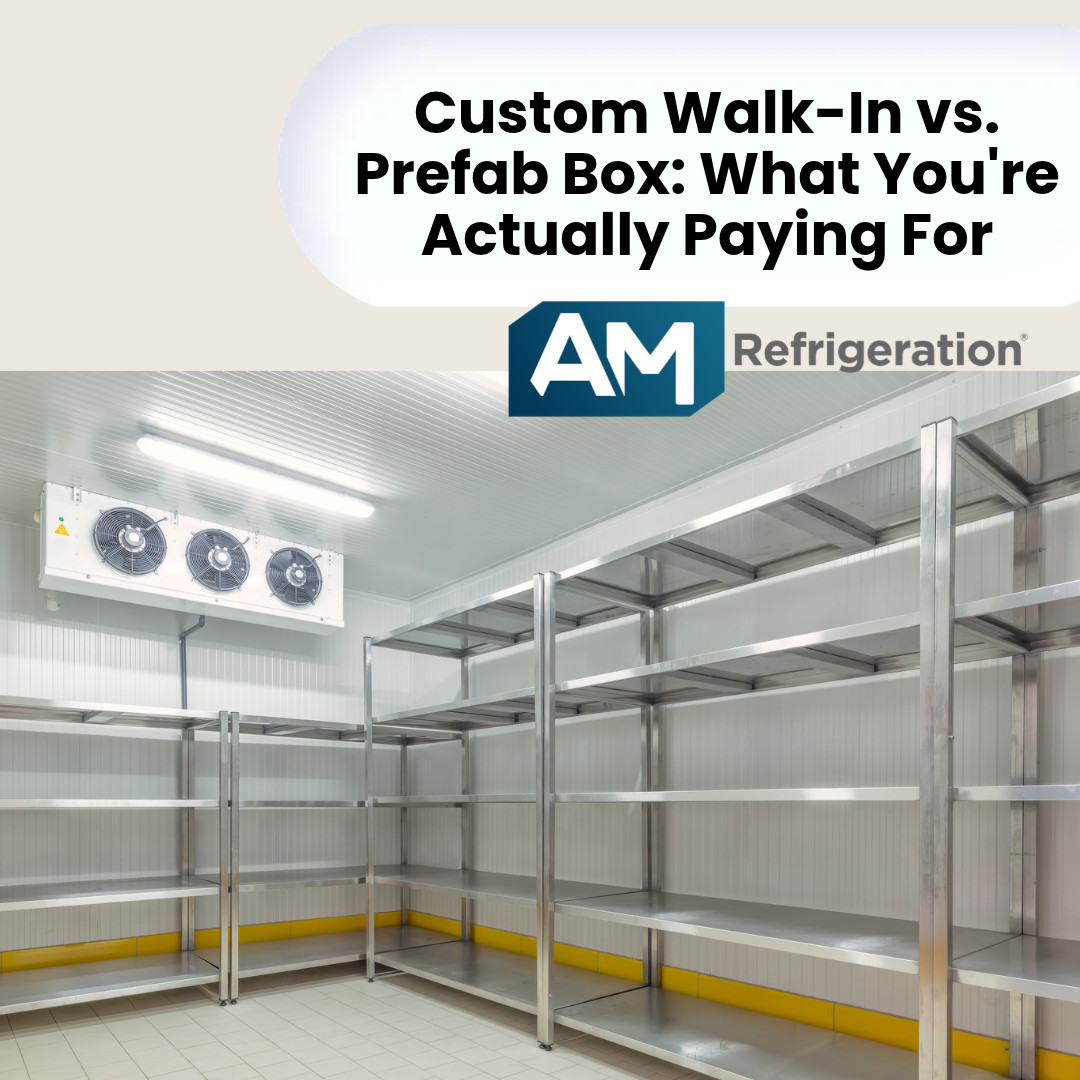
A walk-in cooler looks simple. Four walls, a door, a box that stays cold. So when two quotes land on your desk and one is noticeably cheaper, it's tempting to go with the cheaper one and move on.
Sometimes that's the right call. But a walk-in is one of the hardest-working pieces of equipment in your business. It runs 24/7, holds thousands of dollars in product, and in El Paso, it fights 105°F heat every summer. The difference between a box that fits your operation and one that sort of fits shows up every single day, on your energy bill, in your prep flow, and eventually on a service call.
Here's an honest breakdown of what you get with each option, and how to figure out which one makes sense for you.
First, what's the difference?
A prefab walk-in is built from factory-made modular panels in set sizes and heights. You pick dimensions from a menu, it ships, and it gets assembled on site. Many come paired with a packaged refrigeration system designed to match the box.
A custom walk-in is designed around your space and your operation. The dimensions, door placement, sections, floor, and refrigeration system are all planned for how you actually use it. At AM Refrigeration, we build custom walk-ins in-house, so the box and the system are designed together.
Both are legitimate options. The question is which one fits your situation.
When prefab makes sense
We'll be straight with you: prefab isn't the bad guy. It's a good fit when:
• Your space is a clean rectangle with no columns, low ceilings, or awkward corners to work around.
• Your needs are simple. One temperature, moderate door traffic, standard shelving.
• You're on a tight timeline and a standard size will do the job.
• The box is going indoors, in a conditioned space, away from direct sun.
If that sounds like you, a well-installed prefab box with a properly sized system can serve you well for years.
Where prefab starts costing you
The problems usually aren't the panels. They're the gaps between a standard box and a non-standard business.
1. The wrong size, every day
Standard sizes force a choice: go smaller than you need, or bigger than your space allows. Too small, and staff overload shelves, block airflow around the evaporator, and leave the door open longer while they dig for product. Too big for the space, and you lose prep room or end up with a layout that slows the kitchen down.
2. A door in the wrong place
Door placement sounds minor until you watch a busy Friday night. A door that opens into a traffic lane, swings the wrong way, or sits far from where product gets used means more trips, longer openings, and more warm air pouring in. Every one of those openings is load your refrigeration system has to pull back out.
3. Refrigeration sized for somewhere else
This one matters a lot in West Texas. Refrigeration equipment is rated at standard conditions, and a lot of packaged systems are sized with milder climates in mind. When the condensing unit is sitting on a roof or outside wall in 105°F heat, its capacity drops right when your box needs it most.
A system sized for your actual product load, door traffic, and El Paso summer conditions runs shorter cycles, holds temperature better, and puts less strain on the compressor. That's the difference between a box that coasts through July and one that's running nonstop and still struggling.
4. Outdoor installs that weren't built for the desert
Short on indoor space? Lots of businesses put walk-ins outside. That box is now dealing with direct sun on the roof and walls, dust, and monsoon downpours. An outdoor walk-in needs a weatherproof roof, proper sealing, and a refrigeration system that accounts for the extra heat load. A standard indoor box with a cap on top is asking for leaks and high bills.
5. Freezers and floors
Walk-in freezers need properly insulated floors. Without the right floor design, cold can migrate into the slab below, which can lead to ice buildup and even floor heaving over time. With a custom build, the floor gets planned as part of the box, not treated as an afterthought.
Think lifetime cost, not sticker price
A walk-in isn't a one-time purchase. It's something you'll pay for over its whole life, in a few different ways:
• Energy. A box that leaks cold air through a poorly placed door, or a system that runs nonstop in the heat, shows up on every utility bill for as long as you own it.
• Wear and repairs. An undersized system works harder and longer, and compressors that run constantly tend to wear out sooner.
• Product loss. If the box can't hold temperature on the hottest afternoons, you're risking inventory, and in a restaurant, food safety.
• Workflow. Extra steps for your staff, every shift, add up. It's hard to put on a spreadsheet, but your kitchen manager will feel it.
None of this means custom always wins. It means the cheapest quote and the cheapest walk-in aren't always the same thing. The right comparison is what each option will cost you over the next 10 to 15 years, not just on install day.
A tale of two kitchens
Here's a simple example of how this plays out. It's an illustration, not a real customer.
Two restaurants on the same street each need a new walk-in. Both have a tight back-of-house with a support column right where the box needs to go.
The first goes with the lowest-priced standard box. To clear the column, they size down. The door ends up facing away from the prep line, so cooks walk around the box a dozen times a shift. By August, shelves are packed tight, the door is open longer while staff dig for product, and the condensing unit on the roof is running almost nonstop.
The second goes custom. The box wraps around the column, keeping the space they need. The door faces the line. The system is sized for their summer load. It costs more on day one, but it runs shorter cycles, holds temperature through the worst of July, and doesn't slow the kitchen down.
Same street, same heat, very different summers.
What you're paying for with custom
When you pay more upfront for a custom walk-in, here's what that money is actually buying:
• A box that fits. Built around your columns, ceilings, loading dock, and kitchen flow instead of forcing your space around the box.
• A layout that matches your workflow. Door placement, swing direction, and shelving planned around how product comes in and goes out.
• Combo setups. Cooler and freezer sections in one structure, sharing a wall, so you get both without two separate footprints.
• Refrigeration matched to your load. Sized for what you store, how often the door opens, and what West Texas summers actually feel like.
• One team, start to finish. When the same people design the box, size the system, and service it later, there's nobody to point fingers at when something needs attention.
Questions to ask before you buy either one
Whether you go custom or prefab, these questions will tell you a lot about the quote in front of you:
1. What load is the refrigeration system sized for? Ask what product volume, door openings, and outdoor temperature it was designed around.
2. Where's the condensing unit going, and how hot does it get there? A unit in direct sun on a roof is working in conditions far hotter than the forecast high.
3. Does the box meet federal efficiency standards? Walk-in coolers and freezers sold in the U.S. are covered by Department of Energy efficiency standards. Your contractor should be able to confirm compliance.
4. What's the plan for the floor? Especially important for freezers.
5. If it's outdoors, how is it protected? Roof, sealing, drainage, and sun exposure all need answers.
6. Who services it after install? A great box with no local service support is a risk, especially in the middle of summer.
The bottom line
Prefab is the right answer for some businesses. Custom is the right answer for others. The wrong move is choosing on upfront price alone, because a walk-in that doesn't fit your space, your workflow, or your climate keeps costing you long after the invoice is paid.
AM Refrigeration has been building and servicing walk-ins for El Paso, Las Cruces, and West Texas businesses since 1976. If you're planning a new walk-in, replacing an old one, or just comparing quotes, we're happy to talk through what makes sense for your space, even if the answer is the simpler option.
Talk to us about your walk-in: 915-562-2122